
Cadence, or how many times in a minute you make a step (SPM, steps per minute) can make a significant difference to running form and recovery. Many of us believe that if we take big galloping steps, we’ll run quickly, however the reverse is generally true. Taking more smaller steps will reduce impact and also ensure that you run with good form. There are a number of reasons for this:
Energy efficiency: If you take big strides, you move up and down more, thereby wasting energy in a vertical plane. When running, concentrate on spending energy on going forward, not up and down. Less air time, more forward motion.
Reduced impact: Smaller steps have less impact on the legs, and are easier on the joints and connective tissue. Your body will recover better from runs. Try this for yourself: clapping your hands enthusiastically. Ow! When you make your handclaps smaller and gentler, it doesn’t hurt the palm of your hands. Or if you’re able, jump up and down, then make the jumps smaller. See?
Less injuries: It’s easier to manouevre with a higher cadence, Just think of it as more opportunity to avoid obstacles and change direction. So you’re less likely to trip over, and also will have a quicker post-run recovery as the muscles and joints won’t be so bashed about.
Run faster: yes, you read that right. Smaller steps may help you run faster. The ‘golden number’ of steps per minute is 180 spm. Obviously different leg length may mean you have a different optimal cadence.
Perform like a pro: If you watch elite athletes, you’ll notice that they take lots of (often very fast) steps. They know it works. Or watch the Tour de France - pro cyclists are aware that a lower gear with a faster cadence (how quickly they pedal), will mean their legs aren’t so fatigued and that they can cycle faster, longer. Their legs “go like the billy-o” as my gran used to say…
I’ve included a hand-drawn diagram below so you can understand the mechanics of a shorter stride.
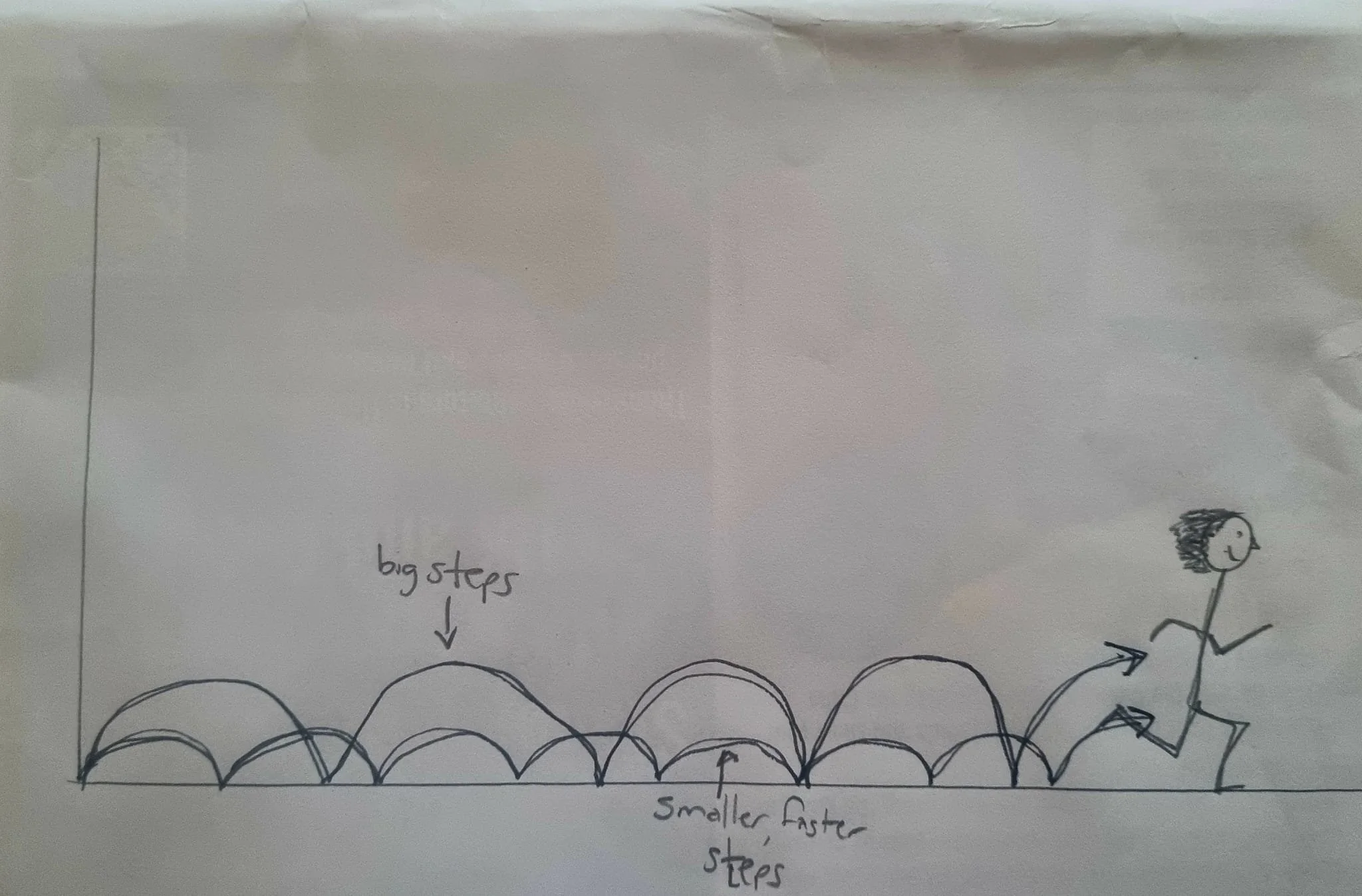
How to speed up your running cadence:
- Install a free metronome app on your phone. There are many to choose from and they keep changing, so I’ll not recommend one here, you just choose what works best on your device.
- Before you run, set the metronome for 180bpm and make sure your headphones connect OK.
- Start your run as usual, then after 5 minutes, put on the metronome and match your feet to the beat.
- It may be frustrating to start, as it will feel like you’re going slower.
- Try a second and third cadence run, with a high cadence from the start. See how long it takes you do to your usual run. I found my easy 5km time was improved by about 30 seconds.
- With practise it’ll become normal. You can always do big strides to sprint finish, as you’ll have the energy to do it!
- You can also find 180bpm playlists on Spotify and other streaming services, however I prefer a metronome specifically to train SPM so I’m not distracted by whether or not I like a particular song. When you get going with a high cadence, you’ll not want to stop and skip tracks so a non-distracting metronome is good for focusing the mind and body.
Possible Exceptions:
- Hoka and highly cushioned shoes are designed with impact in mind. They’re engineered to give you a ‘spring in your step’ so you literally bounce along. They may help you go faster, but the instability of the cushioning can niggle weak ankles and knees. Foot strength may also be compromised, but that’s the subject of another blog post.
- Running downhill is a good time to lengthen your stride. Lean down the hill and take bigger strides to really fly. A good rule of thumb is little steps up a hill, big steps down. Your quads might complain a few days later though…
PT Tracy has over 20 years experience teaching clients how to run faster, easily.
Drop her a line if you’d like to know more.
Run specific webcam sessions also available if you’re not in Edinburgh.
